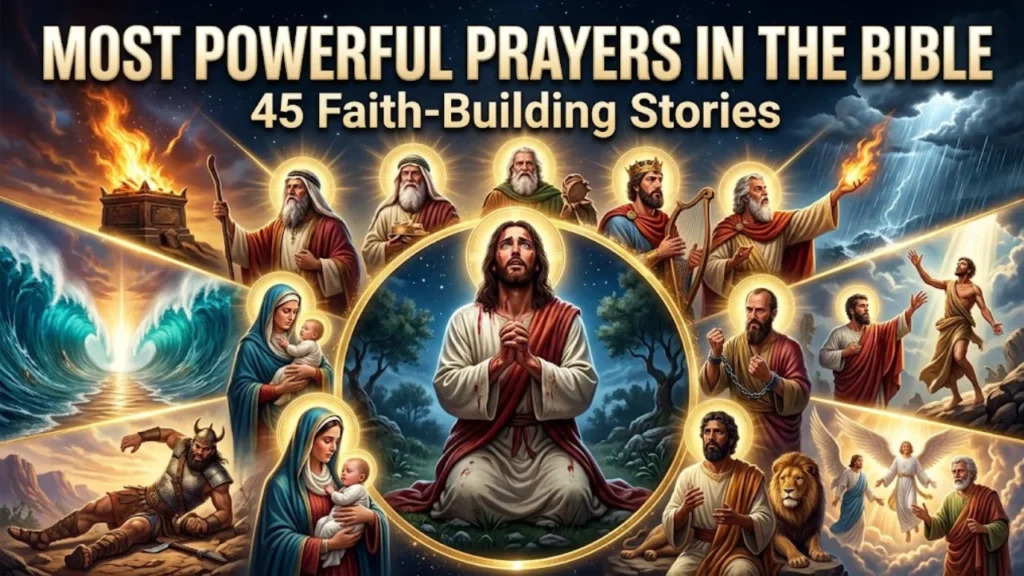
Prayer is one of the most powerful acts of faith a human being can perform. Throughout the Bible, God’s people prayed in deserts, prisons, temples, battlefields, and even inside a fish. And God heard every single one.
This article covers 45 people who prayed in the Bible — their stories, their prayers, and the life-changing lessons we can still apply today. Whether you are new to prayer or looking to deepen your prayer life, these examples will strengthen your faith.
Old Testament People Who Prayed and Saw God Move
The Old Testament is full of powerful prayers. These men and women cried out to God in their darkest hours — and He answered. Here are the key figures and what made their prayers so effective.
1. Hannah — The Prayer of a Desperate Mother
Hannah was childless for years. In ancient Israel, that brought deep shame and heartbreak. She went to the temple and wept bitterly before God (1 Samuel 1:10). She made a sincere vow: if God gave her a son, she would dedicate him to the Lord.
God remembered Hannah. She conceived and gave birth to Samuel — one of the greatest prophets in Israel’s history.
What this teaches us: God hears prayers rooted in genuine anguish and faith. You can bring your deepest pain directly to Him.
2. Abraham — Interceding for Sodom and Gomorrah
When God revealed His plan to destroy Sodom, Abraham did not stay silent. He boldly interceded for the righteous people in the city (Genesis 18:22–33). He negotiated with God — not out of arrogance, but out of compassion for his nephew Lot.
God listened. Lot and his family were safely brought out before destruction came.
What this teaches us: Intercessory prayer — praying for others — moves the heart of God. You can pray for people who cannot or will not pray for themselves.
3. Moses — Crying Out for the People
Moses prayed constantly for the nation of Israel. When the people sinned with the golden calf, Moses stood in the gap and begged God not to destroy them (Exodus 32:11–14). God relented.
According to Hebrews 11, Moses is listed among the greatest heroes of faith in Scripture.
What this teaches us: A faithful intercessor can change the outcome for an entire community.
4. David — A Prayer of Deep Repentance
After his sin with Bathsheba, King David did not run from God. He ran toward God. In Psalm 51, he prayed: “Create in me a clean heart, O God, and renew a steadfast spirit within me” (Psalm 51:10, NKJV).
David’s prayer of repentance is one of the most honest and vulnerable prayers in all of Scripture.
What this teaches us: No sin is too great for God’s forgiveness. Honest confession in prayer restores the broken relationship between us and God.
5. Solomon — Prayer of Adoration at the Temple
When Solomon dedicated the newly built temple, he stood before the altar and spread his hands toward heaven (1 Kings 8:22). He praised God for keeping every promise made to his father David.
This is one of the longest recorded prayers in the Bible — a rich prayer of adoration, gratitude, and supplication.
What this teaches us: God honors prayers that acknowledge His faithfulness and His track record of keeping promises.
6. Elijah — Three Powerful Prayers
Elijah prayed three distinct prayers that changed situations dramatically:
First, he prayed for a widow’s dead son — and the boy came back to life (1 Kings 17:21). Second, on Mount Carmel, he prayed for fire to fall and prove God’s power — and fire fell from heaven (1 Kings 18:36–38). Third, he prayed for rain to end a three-year drought — and after seven prayers, heavy rain came (1 Kings 18:42–45).
James 5:17–18 in the New Testament confirms that Elijah was an ordinary man — yet his fervent prayers produced extraordinary results.
What this teaches us: Persistent, fervent prayer works. Don’t stop after one attempt.
7. Hezekiah — Praying for Healing and Deliverance
King Hezekiah faced two crises back to back. First, the Assyrian army surrounded Jerusalem. He took the threatening letter from the enemy, spread it out before the Lord, and prayed (2 Kings 19:14–19). God sent one angel — and 185,000 Assyrian soldiers were dead by morning.
Then Hezekiah became terminally ill. He turned his face to the wall and wept before God. God heard him, healed him, and gave him 15 more years of life (2 Kings 20:1–6).
What this teaches us: No situation — not enemies, not sickness — is beyond the reach of prayer.
8. Nehemiah — A Quick Prayer Before a King
Nehemiah’s story shows that prayer does not always need to be long. When the Persian king asked what Nehemiah needed, he prayed quickly in his heart before answering (Nehemiah 2:4). That short, silent prayer prepared him for a conversation that would result in the rebuilding of Jerusalem’s walls.
What this teaches us: Prayer can happen anywhere — even in a royal palace in a matter of seconds.
9. Daniel — 21 Days of Fasting and Prayer
Daniel was one of the most consistent pray-ers in all of Scripture. He prayed three times a day — even when a law was passed making prayer illegal (Daniel 6:10). He was thrown into the lions’ den for it. God shut the lions’ mouths.
In Daniel 9, he fasted, wore sackcloth, and prayed for 21 days seeking to understand a vision. On the very first day he prayed, God dispatched an angel — but spiritual warfare delayed the answer (Daniel 10:12–13).
What this teaches us: God hears your prayer from day one. Sometimes the answer is delayed — not because God isn’t listening, but because He is working.
10. Jonah — Praying from Inside a Fish
Jonah ran from God’s calling. He boarded a ship to Tarshish, a storm came, and he was swallowed by a great fish. From inside the belly of that fish, he cried out to God (Jonah 2:1).
God heard him. The fish spat Jonah onto dry land.
What this teaches us: There is no location too dark, no situation too extreme for God to hear your prayer. Even praying from the lowest point of your life brings God’s response.
11. Jehoshaphat — Praying When Outnumbered
Three armies advanced on Judah simultaneously. Instead of panicking, King Jehoshaphat called the entire nation to fast and pray. He declared: “We do not know what to do, but our eyes are on You” (2 Chronicles 20:12, NKJV).
God’s answer was staggering — He told Judah they wouldn’t even need to fight. The enemy armies destroyed each other. Judah collected the spoils.
What this teaches us: Admitting you don’t have the answers is one of the most powerful positions in prayer for deliverance.
12. Ezra — Corporate Prayer and Repentance
When Ezra discovered that the Israelites had intermarried with surrounding pagan nations, he tore his garments, fell on his knees, and wept before God (Ezra 10:1). His visible grief triggered a massive corporate prayer of repentance. The whole assembly wept bitterly.
Before the journey back to Jerusalem, Ezra also led the people in fasting and prayer for protection on the road (Ezra 8:21–23).
What this teaches us: One person’s sincere prayer can spark a national spiritual revival.
13. Jeremiah — Venting Honestly to God
Jeremiah is sometimes called the “weeping prophet” — and for good reason. After the destruction of Jerusalem, he poured out his grief, frustration, and confusion to God across five full chapters (the book of Lamentations).
He expressed sorrow, anger, and fear — but ended with renewed hope in God’s faithfulness: “The steadfast love of the Lord never ceases” (Lamentations 3:22, ESV).
What this teaches us: God welcomes raw honesty in prayer. You do not have to clean up your feelings before approaching Him.
14. Jacob — Wrestling in Prayer All Night
Before his terrifying reunion with his brother Esau, Jacob wrestled with God all night (Genesis 32:24–30). It was more than a physical struggle — it was a prayer of absolute desperation and faith. He refused to let go until he received a blessing.
God honored his persistence and gave him a new name: Israel, meaning “one who struggles with God and overcomes.”
What this teaches us: Tenacious, relentless prayer — even in fear and uncertainty — is honored by God.
15. Samuel — Interceding for a Nation
When the people of Israel demanded a king, Samuel was displeased. But he prayed to God, and God responded with direction (1 Samuel 8:6). Samuel also declared: “Far be it from me that I should sin against the Lord by failing to pray for you” (1 Samuel 12:23, NIV).
What this teaches us: Praying for others — even those who have let you down — is a spiritual responsibility, not just a personal choice.
16. Samson — A Final Desperate Prayer
Samson had made terrible choices. He had lost his strength, his sight, and his dignity. But in his final moments, he cried out: “O Lord God, remember me and strengthen me just this once” (Judges 16:28, NASB).
God answered. Samson brought down the Philistine temple with his final act of strength.
What this teaches us: It is never too late to turn to God in prayer. Even a broken, fallen person can receive God’s response.
17. Jabez — A Short Prayer With Big Results
Jabez is one of the most overlooked people who prayed in the Bible. His prayer is only two verses long: “Oh, that You would bless me and enlarge my territory! Let Your hand be with me” (1 Chronicles 4:10, NKJV).
The text records simply: “And God granted his request.”
What this teaches us: A short, sincere, specific prayer is just as powerful as a long one.
18. Job — Prayer After Unbearable Suffering
Job lost his children, his health, and his wealth in rapid succession. Yet he continued to bring his confusion and anguish to God. After God spoke to Job from a whirlwind, Job prayed with renewed perspective (Job 42:1–6).
God then restored double everything Job had lost.
What this teaches us: Continuing to pray through suffering — even when God seems silent — leads to restoration.
19. Isaac — Twenty Years of Prayer for His Wife
Rebekah was barren. Isaac prayed for 20 years on her behalf (Genesis 25:21). God finally opened her womb, and she gave birth to Jacob and Esau — two nations.
What this teaches us: Long-term, persistent prayer for someone you love is never wasted.
20. Asa — Crying Out Before a Massive Army
King Asa faced an Ethiopian army of one million soldiers. His own army was much smaller. He prayed: “Lord, there is no one besides You to help in the battle between the powerful and those who have no strength” (2 Chronicles 14:11, NASB).
God struck the enemy, and Asa’s smaller army won a total victory.
What this teaches us: Acknowledging your own weakness in prayer positions God as your strength.
21. Manasseh — The Prayer of the Worst King
Manasseh was one of the most wicked kings in Judah’s history. He practiced sorcery, worshipped idols, and even burned his own children in fire. He was captured and taken to Babylon in chains.
In his distress, he finally humbled himself and prayed to God (2 Chronicles 33:12–13). God heard him, brought him back to Jerusalem, and restored him.
What this teaches us: No past is too dark. God hears the prayer of genuine repentance — no matter who is praying.
22. Manoah — Praying for Guidance in Parenting
When the angel announced that Manoah’s wife would give birth to Samson, Manoah immediately prayed: “Please let the man of God You sent come to us again so that he can teach us how to raise the child” (Judges 13:8, NASB).
What this teaches us: Praying for guidance in raising your children is one of the most important prayers a parent can pray.
23. Habakkuk — A Prophetic Prayer of Faith
Habakkuk looked around at violence, injustice, and suffering and brought those questions directly to God (Habakkuk 1:2). God answered — not always the way Habakkuk expected, but He answered.
In Habakkuk 3, the prophet closes with a stunning declaration of trust: even if everything falls apart, he will rejoice in God.
What this teaches us: It is okay to ask God hard questions. Honest dialogue with God is the foundation of deep faith.
The New Testament reveals a new dimension of prayer — through Jesus Christ, everyone now has direct access to God. Here are the key individuals and groups who demonstrated what prayer looks like on this side of the cross.
24. Jesus — The Ultimate Model of Prayer
Jesus prayed more than any other person recorded in the New Testament. He prayed at His baptism (Luke 3:21), before choosing the twelve disciples (Luke 6:12), at the feeding of the five thousand (Matthew 14:19), and in the Garden of Gethsemane (Matthew 26:36–46).
In Gethsemane — the night before His crucifixion — Jesus prayed three times: “My Father, if it is possible, let this cup pass from Me; nevertheless, not as I will, but as You will” (Matthew 26:39, NASB).
His High Priestly Prayer in John 17 is the longest recorded prayer of Jesus — interceding for His disciples and for all future believers.
What this teaches us: Submission to God’s will — even in agonizing circumstances — is the highest form of prayer.
25. Mary — The Magnificat
When Mary visited her cousin Elizabeth after learning she would carry the Son of God, she burst into a spontaneous prayer of praise (Luke 1:46–55). She praised God for His mercy, His power, and His faithfulness across generations.
What this teaches us: Praise and thanksgiving are prayers. Acknowledging what God has done — or is about to do — honors Him.
26. Paul and Silas — Praying in Prison at Midnight
After being beaten and thrown into prison for preaching the gospel, Paul and Silas did not curse or complain. At midnight, they were praying and singing hymns to God (Acts 16:25). A violent earthquake shook the prison, every door opened, and their chains fell off.
The jailer and his whole household were saved that night.
What this teaches us: Worshipful prayer in the middle of suffering can open prison doors — both literal and spiritual.
27. Peter — Raising Tabitha From the Dead
When Tabitha (also called Dorcas), a beloved disciple, died, Peter was called. He cleared the room, knelt and prayed, then turned to the body and said, “Tabitha, arise.” She opened her eyes and sat up (Acts 9:40).
What this teaches us: Prayer combined with faith can do the impossible. The power behind Peter’s prayer was the risen Christ.
28. Peter and John — Praying for Boldness
After being threatened by religious authorities and ordered to stop preaching, Peter and John returned to their community. Together they prayed for boldness, not escape. The place shook, they were filled with the Holy Spirit, and they kept speaking (Acts 4:23–31).
What this teaches us: When facing pressure or opposition, pray for boldness — not just comfort.
29. Cornelius — A Gentile Whose Prayer Reached Heaven
Cornelius was a Roman centurion — a Gentile — who prayed to God regularly (Acts 10:1–4). An angel appeared to him and said: “Your prayers and alms have ascended as a memorial before God.”
God then orchestrated Peter to come to his household, and Cornelius became one of the first Gentile converts in the early church.
What this teaches us: God hears the prayer of anyone who sincerely seeks Him — regardless of their background.
30. Zacharias — Decades of Prayer for a Son
Zacharias and Elizabeth were both old and had been childless their entire lives. When the angel Gabriel appeared in the temple, he told Zacharias: “Your prayer has been heard” (Luke 1:13). His decades of prayer for a child were answered — and the son born was John the Baptist.
What this teaches us: Prayers prayed years ago are not forgotten by God. He holds them and answers in His perfect timing.
31. Stephen — Praying for His Executioners
As Stephen was being stoned to death for his faith, he looked up to heaven and prayed: “Lord, do not hold this sin against them” (Acts 7:60, NASB). His prayer mirrored Jesus on the cross.
What this teaches us: Prayer for enemies and persecutors is one of the most Christlike acts a believer can perform.
32. The Early Church — Corporate Prayer That Freed Peter
When Peter was arrested by Herod and thrown in prison, the church prayed without ceasing for him (Acts 12:5). An angel came, woke Peter up, and led him out through locked gates. The church was so surprised, they initially didn’t believe it had happened.
What this teaches us: Corporate, persistent prayer by a community of believers is a force that moves heaven.
33. The Disciples — Praying Before Pentecost
After Jesus ascended to heaven, 120 believers — including the twelve apostles and Mary, the mother of Jesus — gathered in an upper room and devoted themselves to prayer for ten days (Acts 1:14). Then Pentecost came. The Holy Spirit fell. Three thousand people were saved in a single day.
What this teaches us: The greatest outpourings of God’s Spirit begin with communities devoted to earnest prayer.
34. Simeon — A Prayer of Fulfillment
Simeon had waited his entire life for one promise: that he would see the Messiah before he died. When Mary and Joseph brought the infant Jesus to the temple, Simeon took Him in his arms and prayed a prayer of peaceful fulfillment (Luke 2:29–32).
What this teaches us: Waiting on God’s promises — sometimes for decades — is always rewarded.
35. Anna — Decades of Fasting and Prayer
Anna the prophetess was 84 years old. She had been widowed after only seven years of marriage. For the rest of her life — roughly 60 or more years — she fasted and prayed in the temple day and night (Luke 2:36–37).
She was in the temple the very day Mary and Joseph arrived with Jesus. She recognized Him as the promised Redeemer and immediately began telling others about Him.
What this teaches us: A lifetime devoted to prayer positions you to recognize and announce the work of God when it arrives.
36. Blind Bartimaeus — Crying Out to Jesus
When Jesus passed by, blind Bartimaeus began crying out loudly: “Jesus, Son of David, have mercy on me!” The crowd told him to be quiet. He cried out even louder (Mark 10:47–48).
Jesus stopped, called him over, and healed him on the spot.
What this teaches us: Refuse to let discouragement silence your prayer. Cry out louder.
37. The Tax Collector — Humble Prayer That Moved God
In one of Jesus’ own parables, the tax collector — a despised figure in Jewish society — could not even look up to heaven. He beat his chest and prayed: “God, be merciful to me, a sinner” (Luke 18:13, NKJV).
Jesus said this man — not the proud Pharisee — went home justified before God.
What this teaches us: Humility is the foundation of effective prayer. God responds to the broken and contrite heart.
38. The Syrophoenician Woman — Persistent Prayer and Faith
This woman was not Jewish, yet she came to Jesus begging for her daughter’s healing. When Jesus initially tested her faith with a challenging response, she did not give up — she persisted with humility and wit (Matthew 15:22–28).
Jesus called her faith “great” — one of only two times He used that word in the Gospels — and healed her daughter immediately.
What this teaches us: Persistent, humble prayer — even in the face of apparent silence — is rewarded by God.
39. The Ten Lepers — Calling Out for Healing
Ten men with leprosy stood at a distance and called out to Jesus: “Jesus, Master, have mercy on us!” (Luke 17:13, NKJV). As they obeyed His instruction to go show themselves to the priests, they were healed along the way.
What this teaches us: Sometimes healing comes while you are in the act of obeying in faith — not before.
40. Paul — Praying Three Times for His Thorn
Paul describes a “thorn in the flesh” — a persistent source of suffering that he prayed about three times (2 Corinthians 12:7–9). God’s answer was not removal but reassurance: “My grace is sufficient for you, for My power is made perfect in weakness.”
What this teaches us: Not every prayer receives a “yes.” Some of God’s greatest gifts come wrapped in a “no” — and in that space, His grace becomes enough.
41. Paul — Praying for the Churches
Paul’s letters are filled with prayers for the communities he founded. In Ephesians 3:16–19, he prays that believers would be strengthened with power through the Holy Spirit, rooted and grounded in love, and able to comprehend the fullness of Christ.
What this teaches us: Praying for the spiritual growth of others is one of the most meaningful forms of intercessory prayer.
42–45: Four More Who Prayed and Were Heard
Moses’ prayer at the bitter waters of Marah — God showed him a tree, the water became sweet (Exodus 15:25).
David’s prayer against Ahithophel’s counsel — “O Lord, turn Ahithophel’s counsel into foolishness” (2 Samuel 15:31) — and God did exactly that.
Elijah’s prayer for a widow’s son — stretched himself over the boy three times and called on God, and the child’s life returned (1 Kings 17:21–22).
Paul and the early church’s prayer at Pentecost — the Holy Spirit came with power, transforming ordinary, frightened people into bold proclaimers of the gospel (Acts 1–2).
People Who Prayed in the Bible Until Something Happened
One of the most encouraging patterns across Scripture is the power of persistent prayer. These are not stories about one-time requests. They are accounts of men and women who kept praying until heaven responded.
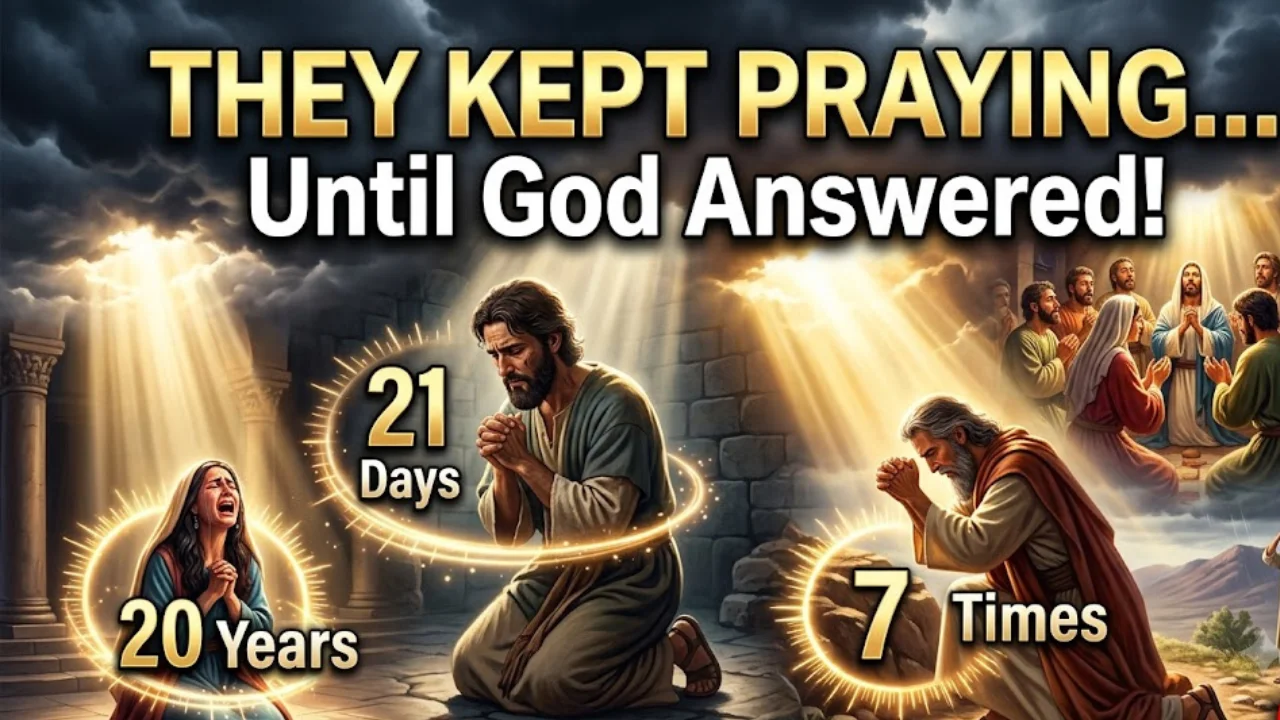
Hannah went to the temple and prayed for years. The Bible records her returning season after season, bringing her grief to God. When God finally opened her womb, she gave birth to Samuel — the prophet who would anoint Israel’s first two kings.
Daniel prayed and fasted for 21 consecutive days. The angel told him that God had sent an answer on the very first day of his prayer, but a spiritual battle had delayed the messenger (Daniel 10:12–13). His persistence mattered.
Elijah prayed for rain seven times on Mount Carmel (1 Kings 18:42–44). After the sixth prayer — nothing. He sent his servant to look toward the sea again. On the seventh time, a small cloud appeared. Then the rain came in torrents.
The Early Church prayed night and day for Peter while he was in prison under Herod (Acts 12:5). They “continued earnestly” — the Greek word suggests they were stretching forward in fervent, determined prayer.
Isaac prayed for his barren wife Rebekah for 20 years before God answered (Genesis 25:20–21). The answer when it came brought not one child but twins.
Key truth: The James 5:16 principle confirms this — “The effective, fervent prayer of a righteous man avails much” (NKJV). Fervent, persistent prayer in the Bible produces results. According to a Pew Research Center survey, 55% of Americans report praying daily — yet many give up when the answer does not come quickly. Scripture calls us to keep asking, keep seeking, keep knocking (Matthew 7:7–8).
Where People Prayed in the Bible — Sacred and Surprising Locations
Most people assume prayer only belongs in a church building. But people who prayed in the Bible did it in some of the most unexpected places. This completely shatters the idea that God is only accessible in a formal setting.
The Temple — Solomon, Hezekiah, Anna, and Zacharias all prayed in the temple. This was the designated meeting place between God and His people. It represented reverence, holiness, and covenant (1 Kings 8; Luke 2).
The Wilderness — Moses, Elijah, and Jesus all prayed in the wilderness. The desert stripped away distractions and created radical dependence on God. Jesus fasted 40 days in the wilderness before beginning His ministry (Matthew 4:1–11).
A Prison Cell — Paul and Silas prayed and sang hymns at midnight in a Philippian prison (Acts 16:25). The walls of a cell could not contain their worship or block God’s ears.
Inside a Fish — Jonah prayed from the stomach of a great fish (Jonah 2:1). If God can hear prayer from inside a marine creature in the depths of the ocean, He can hear yours wherever you are.
A Garden — Jesus’ most agonizing prayer was in Gethsemane, an olive garden at the base of the Mount of Olives (Matthew 26:36). Gardens appear repeatedly in Scripture as places of encounter with God — from Eden to the empty tomb.
A Battlefield — Jehoshaphat prayed before a triple-enemy invasion (2 Chronicles 20). Asa prayed with the enemy approaching (2 Chronicles 14). Prayer before and during battle was a regular practice for Israel’s kings.
A Rooftop — Peter was praying on a rooftop at noon when God gave him the vision that would open the gospel to the Gentiles (Acts 10:9–11).
The key takeaway: God is not confined to a building. You can pray in your car, in your kitchen, at your workplace, in a hospital bed, or on a park bench. Prayer is about access, not address.
FAQs
Who in the Bible prayed and got results?
Many people in the Bible prayed and received clear, documented answers. Elijah prayed and fire fell from heaven (1 Kings 18:38). Hezekiah prayed and was healed from a terminal illness (2 Kings 20:5). Hannah prayed and conceived after years of barrenness (1 Samuel 1:19–20). Peter prayed and Tabitha was raised from the dead (Acts 9:40).
Who prayed for 60 years in the Bible?
Anna the prophetess prayed for approximately 60 years or more. According to Luke 2:36–37, she was married for seven years before becoming a widow, and she was 84 years old when she encountered the infant Jesus in the temple. During those decades of widowhood, she “did not depart from the temple, fasting and praying night and day”.
Where did people pray in the Bible?
People in the Bible prayed in a remarkable variety of places. They prayed in the temple (Solomon, Hezekiah, Anna), in the wilderness (Moses, Elijah, Jesus), in a prison cell (Paul and Silas), inside a large fish (Jonah), in a garden (Jesus in Gethsemane), on a rooftop (Peter), on a battlefield (Jehoshaphat, Asa), and in private rooms (Daniel, who opened his window toward Jerusalem three times a day).
Who in the Bible prayed until something happened?
Several people in the Bible demonstrate the power of persistent, unwavering prayer. Hannah prayed for years before conceiving Samuel. Isaac prayed for 20 years for his wife Rebekah to bear children. Elijah prayed seven times before rain came after a three-year drought. Daniel fasted and prayed for 21 days before the angel broke through with the answer.
Conclusion
Across both testaments, in palaces and prisons, in temples and open fields, on battlefields and in the belly of a fish — 45 people who prayed in the Bible show us the same truth: God hears. God responds. God never ignores a sincere heart.
They were not all holy people with perfect lives. David was an adulterer and a murderer. Jonah was a runaway. Samson was self-destructive. Manasseh was one of history’s cruelest rulers. But when each of them prayed with genuine repentance and faith, God answered.
The same God who answered Hannah, Daniel, Elijah, and Jesus Himself is listening right now.
I’m Ava Grace, the voice behind CaptionsCap.com. I share funny, cute, and inspiring captions that brighten feeds, spark smiles, and make every post memorable. Words are my playground, and captions are my passion.