Angela Davis has spent more than five decades fighting for freedom, justice, and social change. Her words show up in classrooms, protest signs, and social media captions across the country.
This guide brings together her most powerful ideas on freedom, justice, and change, along with the real context behind them. You’ll also find quick answers to the questions people search for most about her life and work.
Who Is Angela Davis? A Quick Look at Her Life and Legacy
Before diving into her quotes, it helps to know who’s speaking. Angela Davis isn’t just a source of inspiring lines — she’s a scholar, author, and prison abolitionist whose ideas shaped modern movements.
Angela Yvonne Davis was born in Birmingham, Alabama, in 1944, in a neighborhood nicknamed “Dynamite Hill” because of the frequent bombings targeting Black families who moved in. She grew up during the height of Jim Crow segregation, which shaped her lifelong focus on racial justice.
She studied philosophy under Herbert Marcuse and later became a professor at UCLA, where she was fired in 1969 because of her membership in the Communist Party — a decision the university later reversed. In 1970, she was placed on the FBI’s Ten Most Wanted list after guns registered in her name were used in a courtroom incident. She was arrested, jailed for over a year, and eventually acquitted by an all-white jury in 1972.
That trial made her a global symbol of resistance against the prison system. She went on to write several influential books, including Women, Race & Class and Are Prisons Obsolete?, and became a professor emerita at the University of California, Santa Cruz.
Her work laid the intellectual groundwork for what’s now called prison abolition — the idea that incarceration doesn’t solve social problems, it hides them.
Angela Davis Quotes on Freedom
Freedom is the thread running through almost everything Angela Davis has written or said. For her, freedom isn’t a personal feeling — it’s a collective condition.
1. “I am no longer accepting the things I cannot change. I am changing the things I cannot accept.” This is arguably her most quoted line. It flips the well-known Serenity Prayer on its head, replacing quiet acceptance with active resistance.
2. “You have to act as if it were possible to radically transform the world.” Davis often frames freedom as an ongoing practice, not a one-time achievement. Action has to be constant, not occasional.
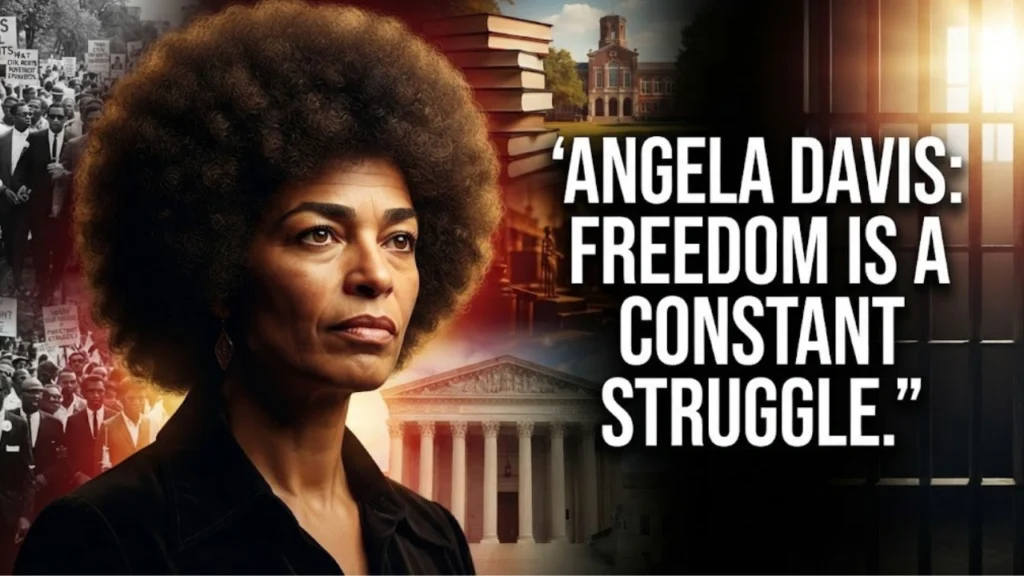
3. “Freedom is a constant struggle.” This phrase became the title of one of her books. It captures her core belief: freedom is never finished — it has to be defended and renewed by every generation.
4. “Radical simply means grasping things at the root.” She uses this to reframe the word “radical,” which is often treated as an insult. For Davis, radical thinking just means looking past surface symptoms to root causes.
5. “Walls turned sideways are bridges.” A short, visual way of saying that the same structures used to divide people can be reimagined as tools for connection.
6. “We know the road to freedom has always been stalked by death.” This line points to the real, historical cost paid by civil rights activists, and it’s part of why her writing carries weight beyond slogans.
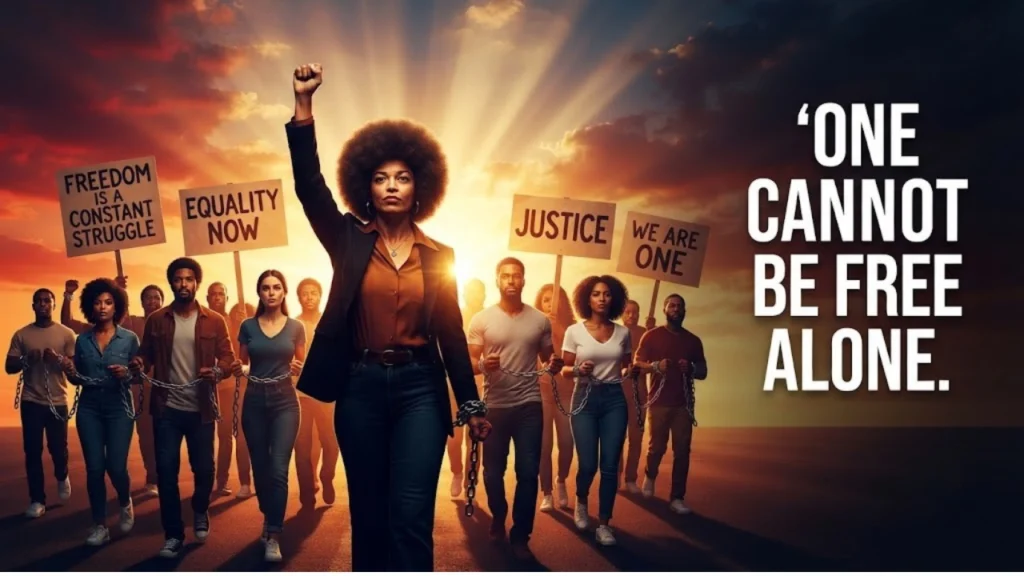
7. “One cannot be free alone: freedom is collective.” This idea shows up again and again in her talks. Personal liberty, she argues, means little if the community around you isn’t also free.
Together, these lines on freedom show a pattern: Davis rarely talks about liberty as something an individual owns. It’s something a society builds, together, on purpose.
Justice and change are where Davis’s academic background and activist history meet. Her quotes here focus heavily on prisons, racism, and systemic reform rather than individual behavior.
8. “Prisons do not disappear social problems, they disappear human beings.” This is the closest thing to a thesis statement for her decades of prison abolition work. It argues that incarceration hides poverty and inequality instead of fixing them.
9. “In a racist society, it is not enough to be non-racist. We must be anti-racist.” Long before “anti-racism” became a mainstream term, Davis was drawing this exact distinction between passive neutrality and active opposition.
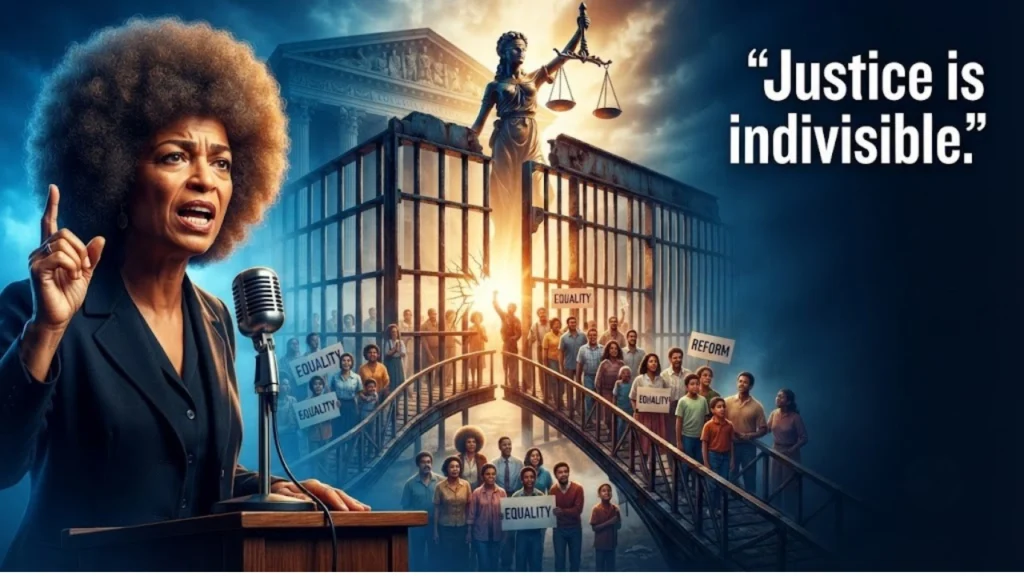
10. “Justice is indivisible. You can’t decide who gets civil rights and who doesn’t.” She uses this to argue that partial justice — rights for some groups but not others — isn’t justice at all.
11. “Past struggles cannot correct current injustices.” A reminder that historical progress doesn’t automatically solve today’s problems. Each era, she argues, has its own fight.
12. “We are never assured of justice without a fight.” Short and direct — justice, in her framework, is never handed down. It’s won.
13. “Movements are most powerful when they begin to affect the vision of those who do not necessarily associate themselves with those movements.” This is one of her more strategic insights: real change happens when a cause reaches beyond its original supporters.
14. “The challenge is not to demand equal opportunity to participate in the machinery of oppression, but to dismantle those structures.” This line separates her thinking from simple equal-representation politics. She’s after structural change, not just a seat at the existing table.
15. “Imprisonment is increasingly used as a strategy of deflection of the underlying social problems — racism, poverty, unemployment, lack of education.” This connects directly to modern data. The U.S. incarcerates people at one of the highest rates in the world, with over 1.9 million people in prisons and jails as of recent Bureau of Justice Statistics figures.
Reading these together, a clear pattern of social justice thinking emerges: real change comes from structural shifts, not symbolic gestures.
Angela Davis Quotes on Feminism, Education, and Everyday Inspiration
Davis’s feminism is tied closely to race and class — she rarely treats gender as a standalone issue. Her education quotes follow the same logic: learning should serve liberation, not just careers.
16. “Feminism involves so much more than gender equality. It has to involve a consciousness of capitalism, racism, colonialism, and more genders and sexualities than we ever thought we could name.” This quote is often cited as an early, mainstream articulation of intersectional feminism — years before the term became widely used online.
17. “To understand how any society functions, you must understand the relationship between the men and the women.” A compact way of saying gender dynamics reveal a lot about a culture’s power structures.
18. “Birth control — individual choice, safe contraceptive methods, and abortions when necessary — is a fundamental prerequisite for the emancipation of women.” This appears in her book Women, Race & Class, connecting reproductive rights directly to broader freedom.
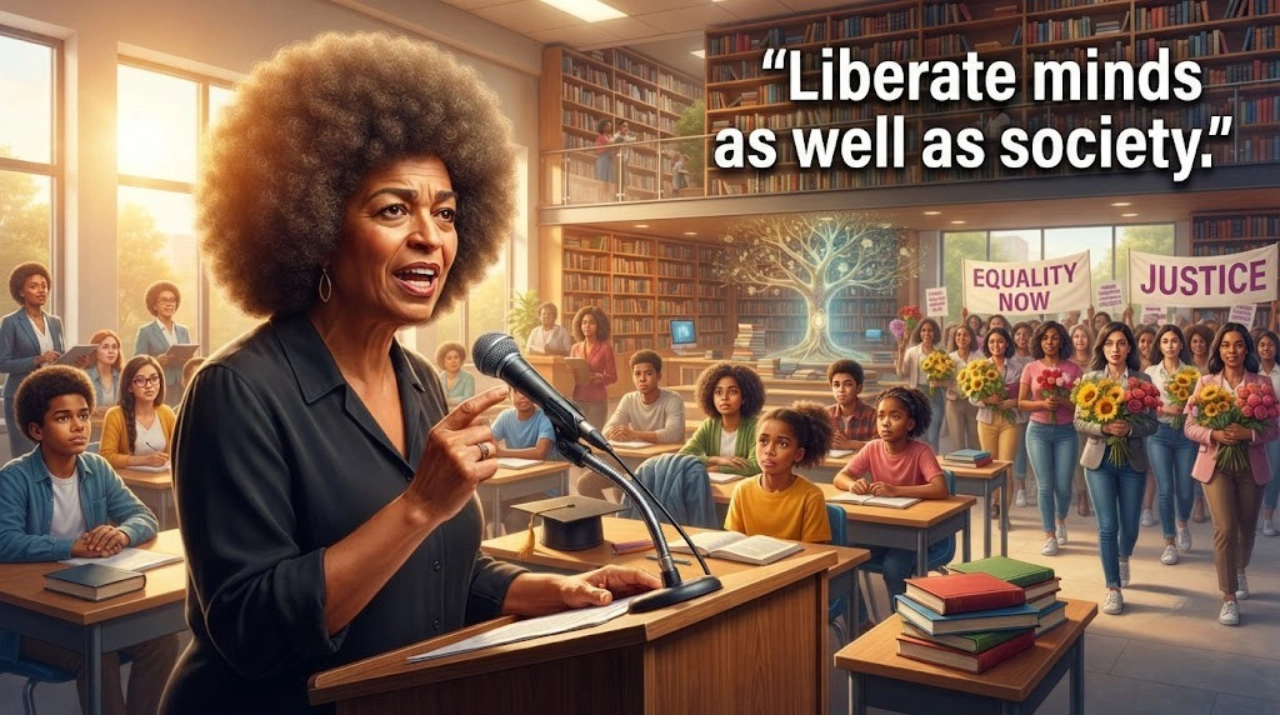
19. “We have to talk about liberating minds as well as liberating society.” A bridge between her feminism and education work — she treats mental and cultural change as just as necessary as legal change.
20. “When children attend schools that place a greater value on discipline and security than on knowledge, they are attending prep schools for prisons.” This quote is frequently cited in discussions about the “school-to-prison pipeline,” a term researchers use to describe how harsh school discipline policies correlate with higher incarceration rates later in life.
21. “If knowledge is to have any meaning, it should have an impact in the world.” Simple, but it sums up her whole approach to academia — she’s never treated scholarship as separate from activism.
22. “The process of empowerment cannot be defined by our own class interests. We must learn to lift as we climb.” A reminder that personal success isn’t the same as collective progress.
23. “I try never to take myself for granted as somebody who should be out there speaking. I’m doing it because there’s something important that needs to be conveyed.” A rare glimpse of humility, showing that her public role comes from a sense of duty, not ambition.
These lines on feminism and education show why she’s still assigned reading in gender studies and sociology courses today.
FAQs
What is the most famous quote ever said?
There isn’t one single “most famous quote ever said” — that depends heavily on culture and context. But among Angela Davis’s quotes, “I am no longer accepting the things I cannot change. I am changing the things I cannot accept” is by far her most widely shared and recognized line.
Was Angela Davis LGBTQ?
Yes. Angela Davis has publicly identified as a lesbian and has spoken openly about her sexuality in interviews over the years. She has also connected LGBTQ+ rights to her broader work on racial and social justice, arguing that liberation movements are strongest when they support each other.
Why is Angela Davis so famous?
Angela Davis became internationally known after her 1970 arrest and 1972 acquittal in a high-profile criminal case, which turned her into a symbol of resistance against the U.S. justice system. She’s remained a prominent public figure since then through her academic work, her books like Are Prisons Obsolete?, and her ongoing activism around prison abolition and civil rights.
What does Angela Davis say about feminism?
Davis argues that feminism can’t be separated from race, class, and capitalism. She has said feminism involves “a consciousness of capitalism and racism and colonialism,” meaning gender equality alone isn’t enough — real feminist change has to address economic and racial systems too.
Conclusion
Angela Davis’s quotes on freedom, justice, and change hold up because they’re backed by decades of real action, not just clever phrasing. Whether she’s writing about prisons, feminism, or education, her core message stays consistent: real freedom is built together, and it’s never finished.
If her words resonated with you, her books — especially Women, Race & Class and Are Prisons Obsolete? — are worth reading in full.
I’m Ava Grace, the voice behind CaptionsCap.com. I share funny, cute, and inspiring captions that brighten feeds, spark smiles, and make every post memorable. Words are my playground, and captions are my passion.